

-
Products related to categories: servo, frequency conversion, HMI, driver, distributed DCS, IPC (PC bus industrial computer), PLC (programmable control system), DCS (distributed control system), FCS (field bus system), robot and other products and technical services.
-
Applications: Wind energy, automobile, ship, transportation, manufacturing, aviation, petroleum, natural gas, thermal power, thermal power, nuclear energy, steel, metallurgy, mining, power and other industries
-
Controller PLC\Robot servo drive Electro-hydraulic servo valve\DCS system/Distributed control systemSystem rack\Communication adapter\Analog output\Analog input\
-
\Multi-meter energy meter\Ignition\circuit board\Crimp terminal\Electric ac drive\Low voltage DC power module\Electro-hydraulic\servo valve\Automatic control system\exchange\Network communication module
controller\Processor module\dynamo\Electric machine\Servo drive\Touch screen\Input/output module\Water treatment monitoring system\Automobile\manufacturing system\Thermoelectric control system\ -
Digital output\Digital input\Mechanical protection system\High speed CPU
-
Electric power system\Chemical testing system\Petroleum control system\Tension monitoring system
-
DCS Distributed\control system\Steel control system\Steam\turbine system\Power generation system\
-
Thermal power generation system\Wind power system\Medium and high voltage frequency\conversion system\Precision motion system\Programmable control system\
-
Singapore New Energy Corporation
-
Geylang Bahru Industrial Estate
-
การทางหลวงแห่งประเทศไทย
-
American Petroleum Group
-
Indian shipping works
-
Pakistan Gas Company
-
Russian Automotive Industry Corporation
-
Brazilian Mining Company
-
Bangladesh Hydro power Plant
-
Egyptian Iron and Steel Manufacturing Co
-
Groupe d’exploitation du métro français
-
Für meinen vater
-
Mongolia Wind Farm
-
Empresa venezolana de procesamiento de petróleo
-
alibaba
-
Sichuan Huayingshan Power Plant
-
Huadian Datong Power Plant
-
Guodian Shuangyashan Power Generation Co., Ltd.
-
Baosteel Group Xinjiang Bayi Steel Co., Ltd.
-
Guodian Changzhou Power Plant
-
Xingtai Iron and Steel Co., Ltd.
-
Guodian Fee County Power Generation Co., Ltd.
-
Yangzhou Second Power Plant
-
Sichuan Jintang Power Plant
-
Xingcheng Special Steel Co., Ltd.
-
Quzhou Yuanli Metal Products Co., Ltd.
-
Zijin Mining Group
-
(Bangladesh) Metro Construction Company
-
WuHan steel co., ltd.
-
MaAnShan steel co., ltd.
Honeywell ControlEdge™ HC900 controller
Based on the provided documentation of the Honeywell ControlEdge™ HC900 controller,

the following product summary, application areas, and case studies are presented:
1. Product Overview
The Honeywell ControlEdge™ HC900 is a high-performance, modular process control and safety system designed to simplify engineering implementation and enhance operational efficiency. It combines process control (PLC) and distributed control system (DCS) functionalities with safety instrumented systems (SIS), suitable for ranging from simple single-loop control to complex interlocks and safety applications.
1. Core Features and Value
Process Control and Safety Integration: Capable of running both process control and safety applications within the same controller, using "non-interfering software" technology to ensure that safety functions do not interfere with control functions, thereby reducing total cost of ownership (TCO).
Safety Certification: New SIL-2 certification (verified by TUV), applicable to burner management systems (BMS), emergency stop systems (ESD), and other critical safety applications.
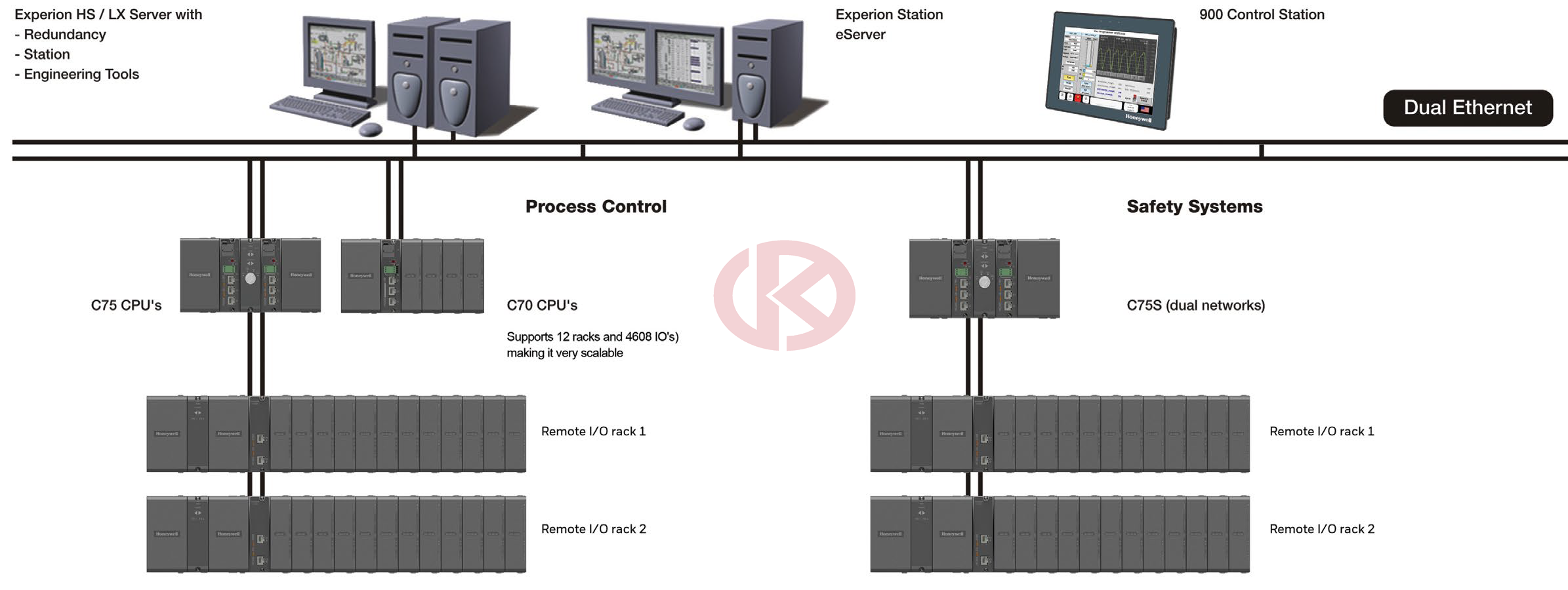
High Reliability and Redundancy: Supports controller redundancy (C75 CPU supported, redundant chassis up to 1 km apart), power redundancy, and communication redundancy, maximizing system uptime.
Easy Engineering and Maintenance: Provides intuitive software tools (such as ControlEdge HC900 Designer), supporting drag-and-drop programming, online configuration editing, batch editing, and version control, reducing engineering time.
Flexible Connectivity: Supports open Modbus/TCP protocol, serial Modbus RTU, HART-IP, and OPC server, facilitating integration with third-party HMI, SCADA, and Honeywell Experion PKS systems.
2. Hardware Specifications and Performance
Controller Model: Offers three performance levels of CPUs, supporting up to 15,000 function blocks.
C30 CPU: Up to 400 function blocks.
C50 CPU: Up to 2,000 function blocks.
C70 / C75 CPU: Up to 15,000 function blocks (supports redundancy).
I/O Capacity:
Total I/O Points: Each system can support up to 4,608 I/O points.
I/O Rack: One controller plus up to 11 remote I/O racks.
Analog Input: Up to 1,152 general-purpose inputs, with an accuracy of 0.1% (field calibration up to ±0.05%), supporting thermocouples, RTDs, and other sensors.
Analog Output: Up to 480 (internal power supply) or 2,304 (external power supply).
Digital I/O: Up to 4,608 points, supporting multiple voltage levels.
SIL General I/O Module (UIO): 16 channels, configurable as DI/DO/AI/AO, supporting 1ms SOE (event sequence recording), line monitoring, HART, and voting/verification functions.
3. Software Functions
Control Strategies: Supports PID, switch, cascade, ratio, three-step motion, etc. control loops.
Advanced Functions:
Fuzzy Overshoot Suppression: Reduces overshoot after setpoint changes or disturbances.
Carbon Potential and Dew Point Control: Specifically for atmosphere control in heat treatment furnaces.
Accutune III: Standard self-tuning function, accelerating startup speed.
Recipe and Sequencer: Supports batch processing and product switching.
Input/Output Voting: Supports 1oo2 and 2oo3 voting and output verification.
4. Operating Environment Operating System: Supports Windows 7 (32/64-bit), Windows 8, Windows 10.
Operating Temperature: 0°C to 60°C (32°F to 140°F).
Certifications: TUV SIL-2, CSA (HazLoc), FM CL1/Div2, ATEX, UL, CE, RoHS, etc.
II. Application Domains
The HC900 system is widely applied in several typical industrial fields due to its extensive compatibility and high reliability:
Chemical: Including specialty chemicals, plastics and rubber.
Life Sciences and Cosmetics: Industries requiring strict compliance and formulation management.
Power: Conventional power industries excluding nuclear power.
Cement and Glass: High-temperature and continuous production processes.
Pulp and Paper: Complex process control.
Mining and Metals: Monitoring and control in harsh environments.
Water and Wastewater Treatment: Municipal and industrial water treatment.
Food and Beverage: Batch production that complies with food safety standards (e.g., FDA 21 CFR Part 11).
Electronics and Semiconductors: Precise control environment.
Textile: Automation of production processes.
Construction and Infrastructure: Subways, railways, HVAC (Heating, Ventilation, and Air Conditioning), etc.
Subways and Road Transportation: Emergency control for tunnel safety and ventilation in tunnels, ensuring traffic safety.
III. Case Studies and Application Scenarios
According to the document description, the HC900 has been widely applied in the following specific scenarios and functions:
1. Safety-related applications
Combustion Control System (BMS): Used for safety monitoring of various heating equipment, including furnaces, boilers, ovens, preheaters, reactors, calcining furnaces, dryers, thermal oxidizers, rotary kilns, furnaces, incinerators, process heaters, and vaporizers.
Emergency Shutdown System (ESD): Automatically places the factory in a safe state upon detecting dangerous situations.
Fire and Gas Monitoring: Real-time monitoring of fire risks and harmful gas leaks in the environment.
Pipeline Monitoring: Integrity monitoring of oil and gas transportation pipelines.
Overflow Prevention: Prevention of liquid overflow in storage tanks or during processes.
Tunnel Ventilation: Emergency control for tunnel safety and ventilation in subways and highways, ensuring traffic safety.
2. Process Control and Optimization Applications
Combustion Control: Optimizing fuel/air ratio to improve combustion efficiency.
Pressure and Flow Control: Maintaining process parameters stable through PID and advanced algorithms.
Heat Treatment:
Carbon Potential Control: Monitoring furnace temperature and probe output, controlling the carbon potential inside the furnace based on zirconium probe input, and including anti-carbon accumulation function.
Dew Point Control: For equipment such as heat-absorbing atmosphere generators, calculating dew point through oxygen sensors.
Terminal Automation: Automation management of oil depots, logistics terminals, etc.
Wastewater Treatment: Automated control of wastewater treatment processes.
3. Batch and Formula Management
Batch Production: In industries such as food and beverage, pharmaceuticals, etc., using the formula function to ensure extremely low error rates for product/process switching.
Setpoint Program: Automatically controlling setpoints for PID loops, creating time/value curves for batch process control.
Sequence Control: Controlling process operation sequences based on time or process events.
4. Data Acquisition and System Integration
OPC Data Integration: Transmitting real-time data to historical databases, HMI (Human Machine Interface), and SCADA (Supervisory Control and Data Acquisition) systems through MatrikonOPC server.
Experion System Integration: Seamless integration with Honeywell Experion PKS/LX/HS system to achieve historical data backfilling and meet the needs of critical data applications (such as pharmaceuticals). Remote Monitoring: Utilizing the embedded Web server functionality, it enables access to the application from anywhere.
5. Industry-specific compliance cases
AMS 2750E Compliance: Meets the key requirements for instrument control, monitoring, and recording in aerospace material specifications (calibration accuracy ±1.1°C/±2°F).
In summary, Honeywell ControlEdge HC900 is a hybrid control system that combines high security, flexible scalability, and ease of use, effectively covering a wide range of needs from single equipment control to full plant integration.
- AEROTECH
- MOOG
- ABB
- HIMA
- GE
- Prosoft
- EMESRON
- EPRO
- rockwell
- Technical Data
- Product Information
- Industry Information
- Company News
- DEIF
- Triconex
- UNIOP
- REXROTH
- Woodward
- Lumentum
- Honeywell
- National Instruments
- Bently Nevada
- MOTOROLA
- FOXBORO
- Enterasys
- KOLLMORGEN
- SIEMENS
- SST
- YOKOGAWA
- sieger
- RELIANCE
- meggitt
- VMIC
- ALSTOM
- EATON
- METSO
- Abaco
- HIRSCHMANN
- Rolls-Royce
- BENDER
- AMAT
- Brand
- ORMEC
- WATLOW
- Schneider
- PRAXIS-Automation
- BASLER
- Kongsberg
- DISCO Corporation
- Bonfiglioli Vectron
-
GE IS420UCSCH2A UCSE controller mounts MARK VIe
-
Rolls Royce DB-S Aquapilot Controller
-
Socapel SERVO CONTROLLER PAM-P1R-H8F-AP-P
-
ABB 3BHE039724R2643 PPD513 Programmable control unit assembly
-
EMESRON FX-490 Positioning Servo Drive
-
GE Fanuc IS215WECAH1A Board Assy MACC-BPPB-WEMD-WECA H1A
-
WOODWARD EASYGEN-3500XT-P1(LT) DIGITAL IO EXTENSION BOARD 8440-2085
-
ABB DH805A HART Communicator
-
honeywell HCIX15-TE-FA-NC HMI
-
ABB NGC8209 Gas Chromatograph with
-
DEIF PPU-2 Generator paralleling and protection unit
-
ProSoft MVI56-MCM Modbus Master/Slave Communication Module
-
GE MTL 8507-BI-DP PAC8000 PROFINET Bus Interface Modules
-
KEBA Injection Molding Machine Mainboard CP035/Z CP035Z
-
Driver board 029.204 687 Alstom igct power unit 029204687
-
Bonfiglioli Vectron ZFB400‑060 FREQUENCY INVERTER
-
GE IS200VRTDH1DAC input module board
-
DATA PATTERNS DP-VME-5114 PMC Carrier Module
-
Rolls-Royce R02TCN-E0L3-00 Remote controller R02TCNE0L300
-
ABB NINT-73C Drive control mainboard NINT73C 64425579A
-
BASLER DECS-250-CN1SN1N Digital Excitation Control System DECS250CN1SN1N
-
GE IS420ESWAH3A 8-port 10/100 base copper only
-
IS420ESWAH1A 8-port 10/100 base copper with one 100 Mbps
-
GE IS420ESWAH2A 8-port 10/100 base copper
-
GE IS420ESWBH1A 16-port 10/100 base copper with
-
GE PQMII-T20-C-A Power Quality Meter
-
GE Mark VI IS230PCAAH1A/B Combination module unit
-
ABB 3BHE021887R0101 UBCC717BE101 Board 3BHB002751R0102
-
ABB 3BHE032593R0001 Isolated Power Supply
-
ABB 3BSC610023R0001 POWER SUPPLY SD812
-
Sleeve matching ABB PFSC230 3BSE081054R1, 25M
-
ALSTOM 029.204431 Power unit module Accessory Mainboard
-
ALSTOM Converteam 029.302250 Power unit module
-
GE IS420UCSBH1A Mark Vle UCSC Controller
-
GE EX2100e Power Conversion Module 151X1235DB15SA1
-
MOOG G122‑829A P-I SERVO AMPLIFIER
-
S-D4017 Remote IO Backplane SSBP-1 RELIANCE drive module
-
CC-link card CCLK-1 S-D4030 RELIANCE drive module
-
Digital IO card DIO-1 S-D4006 RELIANCE drive module
-
S-D4041 DSPM-2A DSP RELIANCE drive module
-
abb 3BUS208720-001 POWER SIGNAL INTERCONNECT
-
GE DS3800NB1A Control Drive Board Serial Port Terminal Board
-
ABB EI813F 3BDH000022R1 communication card
-
TMEIC KPAD-3122A A3XAP02 LCD Display With Key Drive Accessories
-
ALSTOM F425368001 Rupture Disc 110 kV Gas Insulated Switchgear
-
80190-219-01G Allen Bradley Driver Pcb Board IGCT
-
GE DS3815PAHB1A Control Unit Drive Board
-
GE Mark VI IS230JPDGH1B Combination module unit
-
ABB 1MRK002247-Apr04 I/O-modules 670 series
-
ABB 0769143 A CELL SAMPLE AL175MM Gas analyzer accessories
-
RS NX700 Series Controller OEMAX SAMSUNG NX-Y64T
-
RS NX700 Series Controller OEMAX SAMSUNG NX-Y32T
-
NX700 Series Controller OEMAX SAMSUNG NX-X64D 64 output
-
NX-X32D 32 output Series Controller OEMAX
-
NX700 Series Controller OEMAX SAMSUNG NX-POSI4
-
NX-MWLINK Series Controller OEMAX SAMSUNG
-
RS NX-ETHERNET Series Controller OEMAX SAMSUNG
-
NX700 Series Controller OEMAX SAMSUNG NX-DEVICE
-
a-b NX700 Series Controller OEMAX SAMSUNG NX-CPU760C
-
NX700 Series Controller OEMAX SAMSUNG NX-BASE12
-
RS NX700 Series Controller OEMAX SAMSUNG NX-AO4V
-
NX700 Series Controller OEMAX SAMSUNG NX-AI8V
-
PowerFlex® 7000 ForGe Drives which utilize the new HMI Interface Board 80190-780-01-R
-
GCU-08 CB-130 80173-109-01-3 Mitsubishi Thyristor Inverter Power Board
-
a-b 1769-L30 CompactLogix 5370 L3 Controllers
-
A-B MicroLogix™ 1762-OW16 Relay Output Module
-
A-B 1761-ENT-AIC advanced interface converter
-
1761-CBC-PM02 ControlLogix Redundancy System cable
-
A-B 1746-IV16 16DI 10-30V DC SOURCE MODULE SLC 16 Digital Inputs
-
A-B 1746-IB16 module Rockwell SLC 16-point digital input control
-
A-B 1734-MB Memory system memory card
-
A-B 1336-BDB-SP4D 74103-244-54 1336 PLUS II Servo drive power board
-
RELIANCE 0-60067-1 0-60067 Automax Drive Board 0-60067-A
-
RELIANCE 0-60066-1 0-60066 S0-60066 Automax Drive Board
-
Meggitt C327845-11 Flow shutoff valve -7 -5 Parker
-
Driver board 029.204 686 Alstom power unit
-
ABB 3BSE020828R1 DSAI130DK01 Combined analog input module
-
ABB SCC-C 23070-0-101142100000 Continuous Emission Monitoring System (CEMS) Sample gas cooler
-
Siemens 6SE7038-6EK84-1JC2 Inverter Gate Triggering IGD8
-
GE IS200AEPBH1BBA Fan power generation power board
-
ALSTOOM MVS3000-4001 Handheld controller unit
-
PILZ 630613 PSEN OP 4H-S-30-060 Light Curtain Receiver
-
schneider SQUARE D POWERLOGIC CM4250 CIRCUIT MONITOR 96ma
-
EATON E84BAN Crane Control Heavy Duty Mill Limit Switch 2200 VAC 2NO-1NC Contact
-
MVI56 PDP-MV1 ALEN-BRADLEY PROSOFT PROFIBUS UNIT MVI56PDPMV1
-
ABB SCC-C Sample gas cooler 23070-0-10211110
-
GE PN.246B9953BPG1 TOOL-SCR REMOVAL
-
GUTOR BY SCHNEIDER ELECTRIC OP2446 MAIN PROCESSOR BOARD
-
HONEYWELL FX-USI-0002 Universal Safety Interface Module
-
HONEYWELL TA3840S Communication Unit
-
ABB 19P123085397 PDD AVR Unit
-
EMERSON 5X00899G01 Ovation™ Power Supply System
-
ABB 5SHY3545L0020 3BHE014105R0001 5SXE05-0154 IGCT Module
-
4TB5203-0402 Liquid crystal display panel
-
ABB 3BHE036348R0101 Expansion bracket card
-
ABB 3BHE017400R0101 PPD104 Extended memory card
-
ABB 3BHE012049R0001 Fiber Optic Expansion Motherboard
-
ABB 3BHE006805R0001 High Voltage Inverter Motherboard
-
ABB 3BHE000412R0101 INU INTERFACE BOARD
-
ABB UCD208A101 3BHE020018R0101 control board card
-
ABB 3ADT309600R0012 SDCS-CON-2 Terminal UNIT
-
80190-480-01-R Allen Bradley Driver Pcb Board
-
ABB DSMB179 57360001-MS MEMORYBOARD
-
ABB DSMB178 57360001-MM MEMORYBOARD CATALOG DESCRIPTION
-
ALSTOM C264MB1D69500130A300000C000N10 micom C264 ds agile bay controller
-
ABB PFSK138 3BSE014292R1 Channel Control Unit PFSK 138
-
GE ALSTOM 029.380 896 Board Logical control 029380896
-
ABB S-123H 3BHB030479R0112 Power unit ACS 6000 System
-
GE PLB029-376433 Phase-controlled control module of gas compression unit
-
GE IGBT ProX690-1E1-0L0H1 Phase-controlled control module of gas compression unit PLB029-370338
-
GE Industrial System Mark V Display MMI 323A2374P2
-
VMEBUS RACK VME32 BACKPLANE 100-240V/50-60 Hz/1200W
-
IBA ibaLink-SM-128V-i-2oVMEbus Interface Board SM128V
-
VMIC VME-PMC-CADDY VME-Carrier Board for 2 PMC Modules
-
ABB REF620E_1G Feeder Protection and Control
-
ABB SACO16D1 Digital Annunciator Unit
-
ABB REF620 HBFNACNNNEA1BNN11G Feeder Protection and Control
-
GE UT150-2 CPU MODULE CARD FOR CE2000 CONTROLLER
-
ALSTOM TANSFORMER MAINTENANCE KIT 1000KVA UTHC GEC
-
ABB DASD146 3ASC25H270 Lifter controller accessories DASD145
-
ABB DASD147 3ASC25H280 Lifter controller accessories DASD107
-
ABB SCC-K Converter NO2/NO converter and Thermal converter 3KXG801000U0100
-
Siemens 6AV6643-0CD01-1AX1 SIMATIC MP 277 10" Touch
-
ABB UAC095AE01 HIEE300788R0001 Communication Control IO Board
-
ABB AC800PEC Measuring Interface PECMIUAD140 PECMI UA D140
-
ABB 500PSM03 1MRB150038 Power Supply module
-
Valmet metso D201563L Control unit accessories
-
Valmet metso D201473L AII8 Control unit accessories


All new products and surplus products of the industrial intelligence industry, as well as the discontinued products of the original manufacturers. We are not an authorized distributor or representative of any of the above manufacturers (except for brand authorization). The trademarks, brand names and brands appearing in this agreement are the property of their respective manufacturers.
COPYRIGHT© 2003-2026 Copyrighted

Phone(WeChat/Whatsapp)
+086-181 4410 0983
No 1134 Jimei North Road,
Hong Kong Office:
Guan Tang District, Hong Kong,